


ARCHIVED CONCERT NOTES From RVSB Librarian, Ed Wight
Wight’s Insights

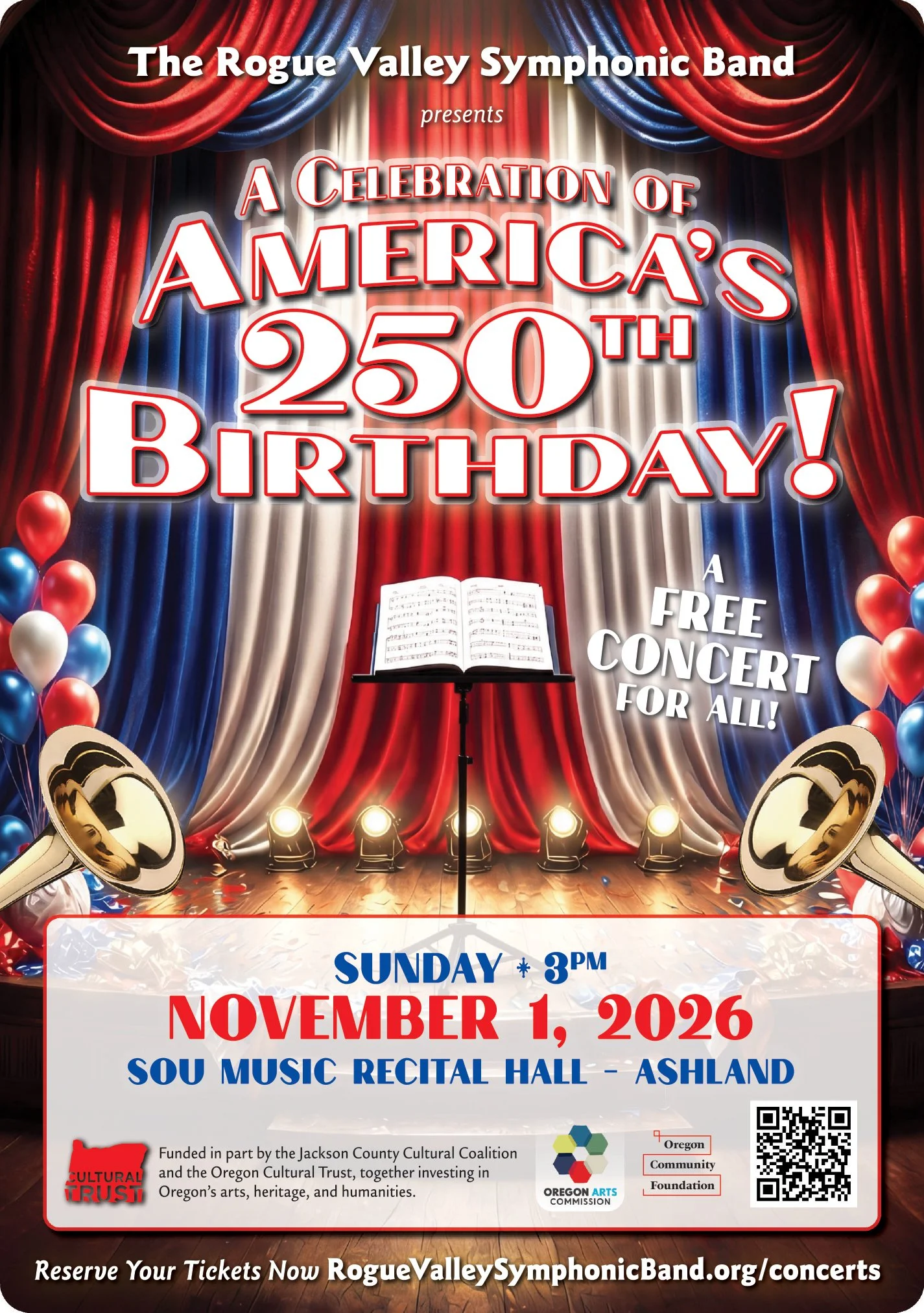
NOTES ON “A CELEBRATION of AMERICA’S 250th BIRTHDAY!”, NOVEMBER 2026 CONCERT
Beginning with a fanfare for military band written in the 1950s, join us for a musical celebration of America’s 250th anniversary. The band offers an extensive tour through the diverse eras and musical styles in our nation’s heritage. We have settings from the Revolutionary War and the Civil War eras, as well as dances from the close of the 19th century. We include a march from the first decade of the 20th century, and a Gershwin medley from the 1920s and 30s. A Copland medley stems from World War II, and we’ll play pieces from the post-war era and beyond - to the later 20th century, and even into the 21st.
AMERICAN OVERTURE
Joseph Jenkins studied music with Vincent Persichetti at the Philadelphia Conservatory, and went on to get a Master’s Degree in composition at the Eastman School of Music. He arranged music for several military bands before joining the music faculty at Duquesne University in 1961, where he taught until his retirement in 2000. Written in 1953, ‘American Overture’ was his first work for bands. He wrote it for the US Army Field Band, and it emphasized their particular strengths. The result was a bit unusual for concert band, as he has three flute parts and four parts for both clarinets and trombones. That band also had an outstanding horn section, and Jenkins features them prominently. Their challenges begin with an immediate octave leap in their first two pitches - and they shine throughout the piece.
CHESTER
American composer William Billings wrote the music and lyrics for the hymn ‘Chester’ in 1770. It became one of the most popular tunes during the Revolutionary War. Almost two centuries later, another American composer, William Schuman, wrote an orchestral piece titled ‘New England Triptych’ in 1956. It has three movements, each of which he based on different hymns by Billings, and the music for ‘Chester’ supplied the finale. Schuman also scored these all three movements for concert band. In ‘Chester’, a chorale version of the hymn opens the piece. Faster variations on that tune dominate the rest of the piece. In the 1950s, the modernist dissonance of the Serialism style was still popular, and Schuman reflects that influence by sometimes setting the hymn in two different keys simultaneously.
TRIBUTE TO STEPHEN FOSTER
Stephen Foster died during the Civil War, at the young age of 38. Yet despite his much-too-early death, the New Grove Dictionary writes that “by the 1850s, he had written the first significant collection of identifiably American songs.” On his death in 1864, a Harper’s Magazine obituary said “his songs are America’s national music.”
Foster often provided an exception to the racist culture of that era. His authentic publications of minstrel songs deliberately avoided the black face and racist caricatures that so often appeared with those songs. And in his 1848 song ‘Nelly was a Lady’ he was one of the first white composers to portray a black husband and wife as a loving, faithful couple.
He has written some of America’s most beloved songs. ‘My Old Kentucky Home’ became Kentucky’s state song, and is played just before every running of the Kentucky Derby. This tremendous jazz-oriented medley by Sammy Nestico offers a star-studded tour of his songs, including that Kentucky song, as well as ‘Jeannie with the Light Brown Hair,’ ‘Oh Susanna,’ and ‘Beautiful Dreamer,’ among many others.
AMAZING GRACE
Originally written as a Christian hymn by English clergyman John Newton, the text was first published in 1779. In America in 1835, it was joined soon with the tune ‘New Britain’ and that is the version currently performed today. Its enduring popularity transcended these sacred origins, and this folk-like hymn now appears in both sacred and secular musical settings.
It quickly developed into one of the most popular black spirituals, and became especially prominent again during the Civil Rights era of the 1950s and 60s. This song was featured in 1979, on a celebration in Atlanta for what would have been the Martin Luther King’s 50th birthday. One of the most internationally celebrated of current American composers, Frank Ticheli, opens his setting with a solo saxophone. That opening is followed by alternating powerful and tender versions, richly scored and harmonized in this rewarding arrangement.
WALLFLOWER WALTZ & RAG
In 1949, Robert Russell Bennett wrote what is still one of the most popular of all American works for concert band. It is a collection of five dances Bennett heard as a child in the first two decades of the 20th century. He originally titled it ‘Electric Park’. the Kansas City dance hall where these tunes were played for public dances. But he soon settled on its current title, ‘Suite of Old American Dances.’ These two excerpts were the fourth and fifth dances Bennett set, both from 19th-century American dance genres.
‘Wallflower Waltz’ features an easy-going version of that dance. It features some rich jazz harmony and sophisticated scoring first emphasizing woodwinds, and later the brass. Ragtime, with its syncopated rhythms, emerged in the 1890s, and for the next two decades was dominated by African-American composers – most notably Scott Joplin. Ragtime blends the traditional two-beat march with Afro-Caribbean rhythms, and that sophisticated syncopation remains a prominent focus throughout ‘Rag.’
Written by RVSB Librarian, Ed Wight
A COPLAND TRIBUTE
When considering the greatest American composers, three names usually top that list – Charles Ives, Duke Ellington, and Aaron Copland. Compared to the modernist, often dissonant style of Ives and the jazz orientation of Ellington, Copland has always enjoyed the broadest mainstream appeal. He is often called the ‘Dean of American Music.’ In 1985, Clare Grundman arranged excerpts from three Copland works in a medley titled ‘A Copland Tribute’ - to honor Copland’s 85th birthday. Our American musical celebration now turns to the 1940s and World War II, as Copland wrote all three works during the war.
It opens with ‘Fanfare for the Common Man’, written in 1942 and based on a patriotic speech by vice president Henry Wallace that year titled “Century of the Common Man”. It recognizes “the common man who was shouldering the burden of all the fighting, and deserved a fanfare.” Grundman next turns to several passages from Copland’s 1944 ballet ‘Appalachian Spring’, including the popular Shaker hymn ‘Tis the Gift to Be Simple’. It closes with two lively excerpts from his 1942 ballet ‘Rodeo’ – “Buckaroo Holiday” and “Hoe Down”.
LAND OF THE EMPIRE BUILDERS
This is a setting by Dr. Martin Behnke of the Oregon State Song: ‘Oregon, My Oregon’. The song was composed in 1920, and the 234th Oregon Army Guard commissioned Behnke’s piece in 1992. He was still in the middle of his 26-year career on the music faculty of Willamette University, where Behnke served as Director of Bands, and often as Department Chair as well. This stirring piece opens as a bright fanfare, followed by a softer, subdued chorale setting of the song. A drum cadence signals the opening of the spirited conclusion, often in lively, full-throated power for the entire band.
OCTOBER
This piece takes our musical tour of America into the 21st century. Eric Whitacre, one of the most prominent modern American composers of band and choral music, wrote this in the year 2000. It was commissioned by the Nebraska Wind Consortium. Whitacre says that “October is my favorite month. Something about the crisp autumn air and subtle changes in light always makes me a little sentimental.” The often soft, atmospheric piece often features dissonance resolving into harmonic warmth, enhanced by sophisticated scoring. It begins softly, later building to a triumphant climax before closing again with some of his favorite soft dissonances.
GERSHWIN!
It would be accomplishment enough for Gershwin to be considered a master songwriter, one of the most prominent composers of the Great American Songbook. From 1915 to 1935 he wrote many of the most popular American songs. Yet Gershwin’s stature reaches far beyond that. None of his contemporary Broadway and Tin Pan Alley pop composers – Irving Berlin, Cole Porter, Jerome Kern, Richard Rodgers and other greats – ventured so effectively into classical music. He wonderfully blended the two genres with jazz-oriented melodies and classical formats - overtures (Cuban Overture), preludes, concertos (Rhapsody in Blue, Piano Concerto in F), tone poems (American in Paris), and opera (Porgy and Bess).
This wonderful medley arranged by Warren Barker focuses on some of his most popular songs, with such up-tempo favorites as ‘Fascinating Rhythm’ and ‘Somebody Loves Me’, along with a couple tender ballads: ‘Embraceable You’ and ‘Someone to Watch over Me.’ It closes in lively fashion with an extended version of ‘I’ve Got Rhythm.’
NATIONAL EMBLEM
We close the concert in stirring fashion, with a march Eugene Bagley wrote in 1902, while touring on a train trip with his band. In a salute to America and its flag, he bases the opening section of ‘National Emblem’ on the ‘Star Spangled Banner.’ But Bagley became dissatisfied with the ending, and threw the piece in the trash. Members of the band retrieved loved the piece, however, retrieved it, and practiced it in secret in the baggage car. At their next concert, the band surprised Bagley by telling him he was conducting it on the program!
Artists are not always the best judge of their work, and ‘National Emblem’ is now recognized as one of the best of all American marches. This rousing piece is especially known for the powerful low brass writing in the trio section. And when the trumpets take that new melody, they single-handedly change the key, in powerful and dramatic fashion. It even became a favorite of America’s march king - John Philip Sousa - who considered it “one of the three greatest marches ever written.”
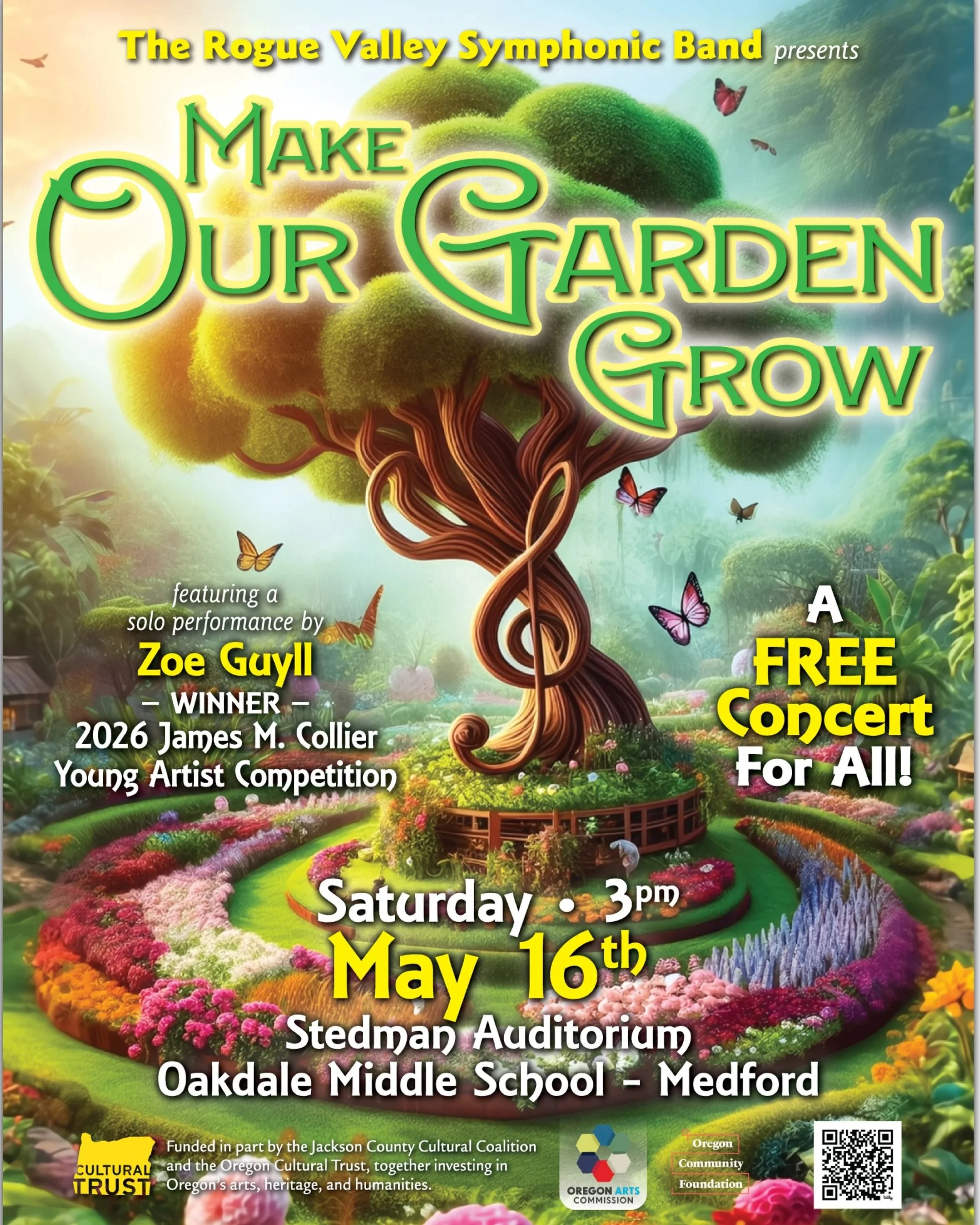
NOTES ON “MAKE OUR GARDEN GROW” MAY 2026 CONCERT
La Flor de Seville (1929)
This concert’s tribute to the welcome season of Spring – its gardens and their flowers – opens with perhaps an unlikely choice: John Philip Sousa. Despite becoming America’s ‘March King,’ he nonetheless began his professional career as a violinist. He wrote many classical orchestral works, primarily operettas, which became popular in their day. But an earlier apprentice for the U.S. Marine Band prompted him to form his own band in 1892. He toured with this band for 40 years, and the marches he composed for it achieved worldwide fame.
The golden era of the American march wa roughly the half century from 1875-1925. It witnessed many fine march composers, such as Henry Fillmore, Edwin Bagley, Karl King, and William Chambers. But none could match Sousa’s extraordinary string of international hits – Liberty Bell, Washington Post, The Thunderer, Manhattan Beach, George Washington Bicentennial – and the grand-daddy of them all as we celebrate the 250th year of the Declaration of Independence: The Stars and Stripes Forever.
Among his other accomplishments, he standardized the form of the concert march. And in all, Sousa wrote over 130 marches. One of his last commissions came from Seville, the Spanish birthplace of his father. He wrote this lively march, La Flor de Seville (‘The Flower of Seville’) on request for the Ibero-American Exhibition in 1929, held in Seville that year. He also demonstrated the same generous international spirit of his earlier march ‘Hands Across the Sea’ when he wrote the inscription on the manuscript for La Flor de Seville: “Written for and dedicated to the people of Spain.”
Concertino (1811)
With Der Freischutz in 1821, Carl Maria von Weber became the “key figure in early German Romantic opera” (Grove Dictionary). And it wasn’t just his remarkable music and lyrics; conducting opera on Dresden and Prague, and with his attention to all aspects of opera (including acting, costumes, scenery, and sets), Weber anticipated many aspects of Wagner’s style by thirty years. His overtures reflect Weber’s operatic penchant for drama and narrative, thus heralding Mendelssohn’s celebrated concert overtures by a decade. He was also a piano virtuoso with “formidable technique” (Grove), and along with notable concertos for his own instrument Weber also wrote them for clarinet, bassoon, and horn as well.
In 1811, Weber met clarinet virtuoso Heinrich Baermann in Munich. His earlier piano concerto already demonstrated a mastery of the genre, and he wrote today’s single-movement Concertino for him. This thematically rich movement in contrasting sections proved so successful that King Joseph of Bavaria immediately commissioned two more clarinet concertos from him that same year! It is performed today by Zoe Guyll, a senior at North Medford High School, and winner of our 2026 James M. Collier Young Artists Competition.
Candide - Make Your Garden Grow (1956)
Previous centuries expected composers to do it all. Such luminaries as Bach, Handel, Mozart, von Weber, Mendelssohn, and Brahms composed their great pieces as well as performing them as conductors and virtuoso musicians. But by the mid-19th and 20th centuries, musicians began to specialize: choosing either composition or mastering their instruments for international concert performance. More than anyone else, Leonard Bernstein provided a remarkable exception to this. He became a piano virtuoso, and could have chosen a solo career. Yet he also became one of the most revered and accomplished conductors of the 20th century. And unlike his only modern rival in all three fields – Rachmaninov as composer, conductor, and virtuoso performer – Bernstein left enduring masterpieces in both classical and pop genres. He wrote symphonies, chamber and piano music, and his 1971 Mass remains one of the great crossover masterpieces of the 20th century.
His great music for Broadway and ballet – Fancy Free, On the Town, Candide, and especially West Side Story - will be performed as long as those genres exist. As a musical, Bernstein’s Candide sets the satirical 1759 novel by Voltaire. After all the episodes of naive foolishness by its title character, he finally realizes the importance of simple productive work, if only in one’s own yard. Bernstein’s gentle and then triumphant finale, Make our Garden Grow, reflects such simple pleasure, as well as the final line of Voltaire’s novel: “We must cultivate our garden.”
Love and Nature (2024)
Gala Flagello is a rising young star among American composers. With performances of her works in seven countries and 39 states, prominent international ensembles such as the BBC Symphony Orchestra, Detroit Symphony, as well as the US Naval Academy Band and the US ‘President’s Own’ Marine Band seek her out. Her wide-ranging compositions cover the field, writing for orchestra, band, choir, chamber and solo works.
The three movements of her 2024 band composition Love and Nature each reflect different aspects of that title. The opening movement, Flower Power, reflects the gentle loving spirit of the 1960s and 70s Haight Ashberry youth movement and its response to power and war. The movement opens with all power in thundering percussion and brass, and active muscular counterpoint. But then a tender spirit dominates; the following gentle theme in the high woodwinds takes the remainder of the movement, even as it dramatically passes to the full ensemble. Star-Crossed opens with a tender theme for hopeful lovers, rising to full triumph – before the conclusion witnesses it sadly slipping away. The finale, Slow burn, features prominent percussion parts suggesting the native American indigenous community’s practice of controlled burns – their power and positive results - to enhance ecological restoration.
when mountains walk (2024)
Alex Gonzalez earned his Doctorate in Musical Arts (Conducting) from Ohio State University. Before assuming his current position as both Director of Bands and teacher of Music Pedagogy on the faculty of SOU. His concerts with the Rogue Valley Symphonic Band have also featured his skills as an arranger and solo guitar player. Now he shares his gifts as a composer as well.
He married a woman from Norway, and when mountains walk was inspired by folk tunes heard when they spent their honeymoon there. But he doesn’t quote any melody in its entirety. Instead, he shares the approach of Antonin Dvorak. Dvorak never used complete Czech folk tunes either. Instead, he used brief fragments of melodies presented in authentic folk style and rhythms. Likewise, Gonzalez ‘reimagines’ fragments, contours, and gestures drawn from Norwegian folk traditions. The title comes from an ancient Norse poem, which reads in part “My love for her will cease when mountains walk.”
Lincolnshire Posy (1937)
Bela Bartok and Zoltan Kodaly transformed our understanding of rural folk music in Eastern Europe. They began taking equipment into the villages of Hungary in 1905-06 to record the songs of local citizens, and by World War I had collected over 8000 folk tunes throughout Eastern Europe and Africa. But their (deserved) notoriety in this regard obscured another folk music pioneer doing the same work in England. Percy Grainger also took recording equipment into the British villages in 1906. “Innovative by temperament, unlike most of his British contemporaries, he enthusiastically supported using the Edison phonograph” (English Folk Dance and Song Society) to collect these folk songs. He called them “my little wildflowers” and began collecting initially in Lincolnshire. Grainger “went on to explore the frontiers of music [much like Bartok] with his idiosyncratic folk song settings...in such band works as Lincolnshire Posy, Irish Tune from County Derry, Children’s March, and Molly on the Shore.
The American Bandmasters Association commissioned Lincolnshire Posy in 1937. Grainger based all six movements on folk songs he collected in that region, and focused on stories of love, loss, sailors, and rural country life. In the Lisbon a sailor and a young woman consider traveling together to Lisbon. Horkstow Grange tells the story of a dispute between a supervisor and his wagoner, and shows Grainger’s rich yet haunting harmonic style at its best. Rufford Park Poachers provides a somber warning to poachers, and the dire consequences as a result.
In the joyful fourth movement, The Brisk Young Sailor happily returns from sea to wed his True Love. Lord Melbourne - subtitled “War Song – depicts the halting, exhausted tale from a soldier about a last battle. Grainger sets The final folk song – The Lost Lady Found - as an ostinato, repeating constantly throughout the movement. The story a happy one, about a kidnapped woman who is ultimately returned to her people. Grainger subtitles it “Dance Song” because you could easily dance to its lively, lyrical melody of constant four-bar phrases.

NOTES ON “ECHOES OF OREGON”, MARCH 2026 CONCERT
The title of RVSB’s March 15th concert - Echoes of Oregon – means the pieces were written either by Oregon or Pacific Northwest composers.
Canticle of the Sun
The composer of our first piece -Dr. Martin Behnke - was born in Yreka, and taught music in public schools and universities in four different states before becoming Director of Bands at Willamette University in Salem, Oregon in 1979. He was also a professional jazz performer on both trombone and piano, and in 1985 won an Oregon Arts Commission Fellowship to study composition with the celebrated American composer Norman Dello Joio. Martin retired from Willamette in 2005 after 26 years, moved to the Rogue Valley, and conducted this band in the 2006-07 season.
For his piece Canticle of the Sun, Behnke turns to the hymn ‘All Creatures of our God and King’ St. Francis of Assisi wrote the text for this hymn text in the early 13th century – and he titled it Canticle of the Sun. This hymn text was later coupled with music from a 17th-century German hymnal. Behnke introduces it by a fanfare, and then intermingles the fanfare and hymn throughout the piece.
Voyage of the Northern Lights
Composer Isabella Morrill was born in Warrenton, Oregon, graduated from Western Oregon University, and in 2019 was co-champion of the Oregon Music Education Association composition contest. She is also a dual citizen of the United States and Finland. Morrill enjoys bringing her Scandinavian heritage into her compositions, which she does in Voyage of the Northern Lights. She offers a musical depiction of an old Scandinavian folktale, in which the beautiful and awesome Northern Lights are actually carrying the fallen Viking warriors up to Valhalla. It won the 2022 National Band Association Composition Contest.
Classical Gas
I don’t think I want to know how many people in this auditorium were alive in 1968 – so I’m not going to ask! But in 1968, the No. 1 song in the country was ‘Hey Jude’ by the Beatles. The Beatles, Rolling Stones, Aretha Franklin, the Supremes, Simon and Garfunkel were all going strong.
But an outsider also crashed the party that year. Singer, composer, classical guitarist, comedian and writer MASON WILLIAMS had his biggest hit that year, Classical Gas. That is our next piece, and in 1968 it sold over a million copies, and won a couple Grammy Awards, including Best Instrumental Composition. On the Crossover Side, his Symphonic Bluegrass has been performed by the Colorado Orchestra, Kansas City Symphony, and the Louisiana Philharmonic among other orchestras. In 1994 he played six sold-out concerts with the Oregon Symphony, and in 1995 he performed at the inauguration for Oregon Governor John Kitzhaber.
Though born in Texas, and he grew up with his mother in Oakridge, Oregon. And he currently lives in Eugene.
Farallones
Our next composer - Megan Vinther - is an Oregon native - but – no one can figure out exactly WHERE she was born in Oregon. Even AI was stumped. But she has remained in the Pacific Northwest, currently a composer, music educator, clinician and multi-instrumentalist in the Seattle area.
The title of our next piece – Farallones – refers to the Greater Farallones National Marine Sanctuary off the Northern California coast – just north of San Francisco. Nicknamed “Devil’s Teeth” and dangerous for early sailors, Vinther attempts to depict the ragged rocks and cliffs in a lively 7/4 meter – with shifting and unpredictable subdivisions. Later some of those themes return in a more regular and stable 12/8 meter, by which Vinther implies the stable future for the ecosystem there.
Tilting at Windmills
We open the second half of the concert with Tilting at Windmills. It was written by our lead trombone player, Mark Jacobs, who also holds the same position in the Rogue Valley Symphony. Mark grew up in West-Central Illinois and earned Masters and Doctoral Degrees in Music at Northwestern University, before moving to the Rogue Valley in 1991. For years he taught Music Theory and low brass at SOU, and wrote program notes for the Rogue Valley Symphony.
Mark continues to write a wide range of music – movie scores, and works for orchestra, band, musical theater and chamber music. The Rogue Valley Symphony premiered his orchestral tone poem – Las Ranas de Katanchel in 2010 and it was recorded by the Moravian Philharmonic Orchestra in 2011 on the Navona label. His band music has also been programmed by several different bands in Europe.
Tilting at Windmills refers to Don Quixote - the great early 17th-century Spanish novel by Miguel Cervantes. Our noble hero is delusional, and at one point mistakes the country windmills as giants who are attacking. He battles them with his lance tilted forward into the fight. In this piece, you will often hear jagged rhythms on the same pitch. Mark suggests Don Quixote’s delusion by one syncopated rhythm in 4/4 bars, and a different but similar sounding one in ¾ bars. Their similarity suggests Don Quixote can’t tell the difference - but let’s hope that THE BAND does
I’m A Stranger Here Myself
Kurt Weill was born in Germany, and started out as a classical composer. But by the time he moved to America in 1935, he devoted himself to Broadway, writing such shows as Knickerbocker Holiday; One Touch of Venus; and Lost in the Stars. Our next piece is “I’m a Stranger Here Myself” and it’s a song from Weill’s 1943 musical comedy One Touch of Venus. Our hero puts his engagement ring on a statue of Venus, she comes to life, and -shall we say – DISTRACTS him from his fiancée who winds up temporarily at the North Pole. It reminds us not to look to closely at the plot of any Broadway or Hollywood musical.
As far as I know, Kurt Weill never set foot in Oregon. But the ARRANGER of this song for concert band, Robert Langslet, grew up in Portland. Our guest vocalist is Parker Schweikert, a voice major at Southern Oregon University.
Contre Qui, Rose
Morton Lauridsen is our one outsider on today’s program, born in Washington and making his retirement home on Waldron Island, of the NW coast of the state. But what an outsider he is!
After growing up in the Pacific Northwest, he became composer-in-residence for the Los Angeles Master Chorale. He also taught on the faculty of USC’s prestigious Thornton School of Music for 52 years before his retirement in 2019. He served residencies as guest composer/lecturer at many universities, and President Bush awarded him the Medal of Freedom in 2007. His eight vocal cycles are best sellers, and with his rich harmonic settings Lauridsen became one of the most internationally prominent choral composers of the later 20th and early 21st centuries.
Our next piece - Contre Qui, Rose – is from one of those choral cycles, Les Chansons des Roses “Rose Songs. The title of the poem by Rainer Maria Rilke translates as “Against whom, Rose” and it asks…
Against whom, Rose, do you need these thorns?
Is your beauty so fragile, you need them?
In these Rose pieces, Lauridsen writes in a gentle, understated style in rich harmony, captured wonderfully in this band arrangement by Robert Reynolds.
Un Cafecito
It’s still true: you cannot tell a book by its cover. Our final piece today - Un Cafecito – carries a seemingly innocent title: ‘A little cup of coffee.’ But this is by far the most challenging piece on the program. The current Director of Bands at the University of Oregon, composer Dennis Llinas carries a Cuban-Columbian heritage which manifests itself here in unending sophisticated rhythmic syncopations. The challenge is to ‘swing’ those rhythms – play them in the spirit intended – while also managing the challenging melodic passages and quick notes. A delightful brew with which to close today’s concert!

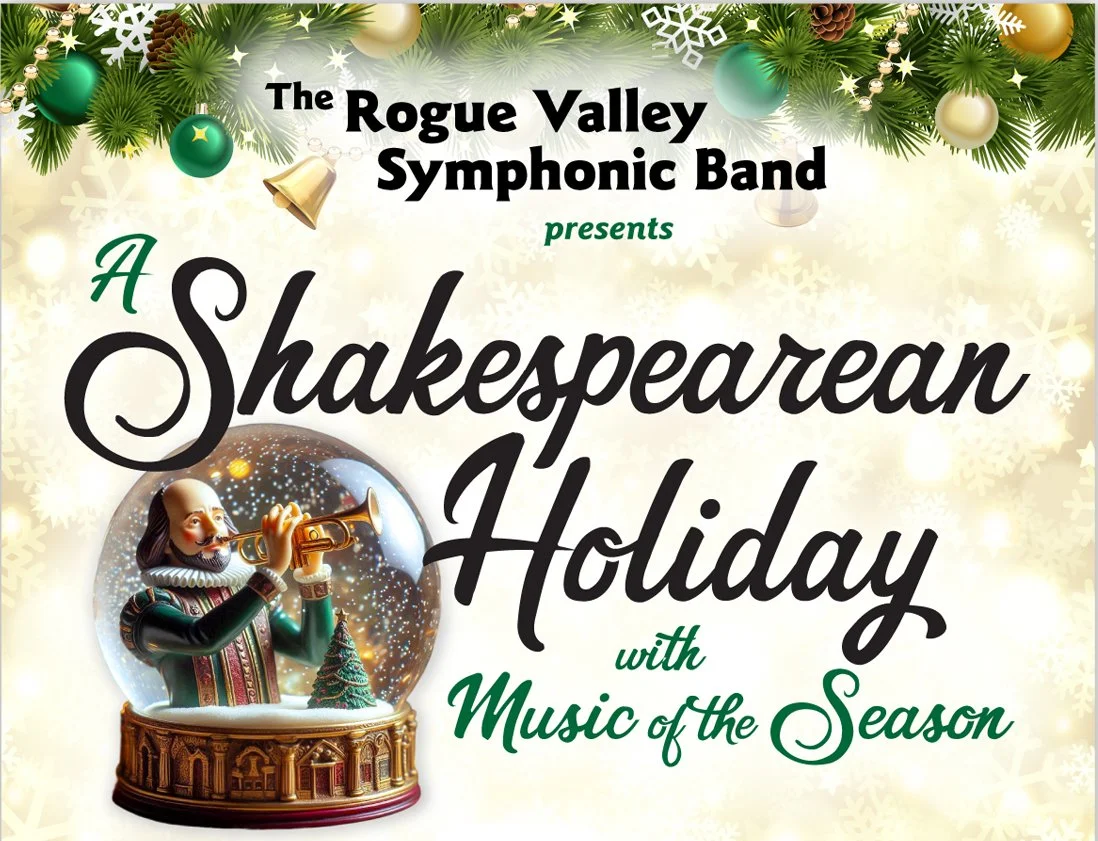
nOTES ON “a shakespearean holiday”, December 2025 cONCERT
Alleluia! Laudemus Te
The Christmas holidays are a time of celebration. Though not written specifically for Christmas, Alfred Reed wrote this as a “Celebration Hymn” – and its spirit provides an appropriate opening for a December holiday concert. Laudemus te translates as “We praise you.” Reed is one of America’s greatest concert band composers, with over 250 compositions played round the world. He wrote this as a commission for the band program at Malone College in Ohio, and when he died in 2005, he had still accepted enough similar commissions for the next 20 years. It begins and ends with a glorious fanfare. In between Reed writes a long lyrical melody for woodwinds and horns (introduced by clarinets) and a more martial theme dominated by the brass. But in typically rich Reed fashion, he lets all sections share in that latter theme.
Eighth Candle
Steve Reisteter composed this piece for a band conductor requesting a work celebrating Hanukah. This holiday commemorates the Jewish fighters known as the Maccabees and their victory over the Syrian forces of Antiochus in 168 BC. In celebration, there was supposedly only enough lamp oil for a single day – but it miraculously burned for eight days instead. In modern celebrations they light candles for eight days, but most Menorahs hold nine candles – the extra one lighting the others.
Reisteter subtitles this piece ‘Prayer and Dance for Hanukah. ‘The piece opens with a contemplative, reverent and hopeful prayer. The Dance – a celebration after the victory – is wonderfully lively, with the free and constantly shifting metric style of Mid-East rhythms – passages is 5/8, 4/4, 5/4 and ¾. Reisteter composed all the themes for the piece. Yet it is so well and authentically written, Jewish conductors have asked him where he found these folk-tunes they hadn’t heard before!
Sussex Mummers
Bela Bartok and Zoltan Kodaly remain justifiably famous for the pioneering ethnomusicological folksong collecting. They began travelling into peasant villages in 1905-06 and making recordings of these songs, then transcribing them. Their first folksong publications appeared in 1906. What is not so well known is that Australian-born Percy Grainger accomplished the same feats in England at that time. He’d settled in England in 1901, joined the English Folk Song Society in 1905, and in 1906 was taking similar recording equipment into English villages to collect the songs. Sussex Mummers was first written down in Sussex in the early 1880s with the title Tipteers or Tipteerers. This gentle piece concludes with a blessing on “Your house, children, cattle and store; may the lord send you more and more.” Grainger made a piano version of it 1911, and later a string orchestra version as well. Richard Franko Goldman urged Grainger to make a concert band arrangement. Grainger agreed, but it was left unfinished at his death – and Goldman completed the arrangement we all perform today.
‘Twas the Night Before Christmas
All the highlights of Clement Moore’s beloved Christmas poem appear in this narration with band accompaniment. Jack Bullock wrote the arrangement, and had a great deal of fun with it. You can’t take this piece seriously for a single moment! Soon after Santa’s sleigh appears, we get a few bars of Handel’s Hallelujah Chorus. When he pops down the chimney, Bullock gives us a quick excerpt of ‘Chim Chim Cher-ee’ from Mary Poppins. And Santa opening his sack is of course accompanied by the familiar strains from Babes in Toyland. Be prepared to chuckle. A lot!
We Wish You a Klezmer Christmas
The Klezmer throughout history were excellent professional musicians in the Jewish communities of Eastern Europe. They performed for festive social and civic occasions, especially weddings and important feast days. Though temporarily prevented from playing on Christian Holy Days, the Archbishop of Prague restored that right in 1741. In the 19th-century, Leipzig Klezmerim performed for Mendelssohn. In the last two centuries, the clarinet has become associated with a traditional Klezmer sound, and We Wish You a Klezmer Christmas opens with a clarinet solo. That is also the last serious moment in the piece, and some traditional Klezmer rhythms and scoring enliven three familiar Christmas carols. We wish you a Merry Christmas, Hark the Herald Angels Sing, and Deck the Hall all appear – in the wrong keys! Mendelssohn wrote ‘Hark the Herald Angels Sing’ and he’s turning in his grave...
A Christmas Festival
LeRoy Anderson’s career demonstrates the importance of excellence – and timing. If there was ever a perfect match between a person and their moment, Anderson provided a wonderful example. His light classical orchestral style, long associated with Arthur Fiedler and the Boston Pops for two decades after World War II, produced hit after hit. His 1952 Blue Tango was the first pop instrumental piece to sell over a million copies. By 1953 a study found him to be the most popular and most-performed American composer on orchestral concerts nationwide – five years after Sleigh Ride became a perennial staple on almost every Christmas concert! In A Christmas Festival, he turns to a series of familiar carols that include audience performance. Join us in a spirited Sing-along of some favorite songs of the season.
Twelfth Night
Alfred Reed’s lighthearted depiction of scenes and characters from Shakespeare’s Twelfth Night provides the centerpiece of today’s concert. Shakespeare set his comedy of gender disguise and the resulting mistaken identity at Christmas time; the title Twelfth Night refers to the festival at the end of the twelve days of Christmas. A shipwreck separates the twins Viola and Sebastian. Now alone, Viola disguises herself as a man for protection. She falls is love with Duke Orsino, but he wants ‘her’ to woo his beloved, Olivia. But Sebastian finally appears and falls in love with Olivia – and she with him. After much hijinks, a double wedding unites all the lovers on the final day of Christmas.
The masque was a staged entertainment involving poetry, music and elaborate sets, reaching its peak in England in the early 17th century. Alfred Reed composed Twelfth Night (2003) in five movements..., calling it “A Musical Masque after Shakespeare.” The band plays four of them. The first movement offers a (primarily) festive Prelude, though a slow middle section hinting at the comic complications to come. The third movement (The Merry Conspirators) depicts the shenanigans involved in tricking Malvolio, who in the 4th movement offers his heartfelt Malvolio’s Lament from prison. In the final movement, after he’s released and all is forgiven, Reed depicts a lively conclusion: A Double wedding, and All’s Well. Twelfth Night contains the great Shakespeare poem “If Music be the food of Love, Play on!” - wonderfully captured throughout by the dean of American band composers, Alfred Reed.
An Irving Berlin Christmas
As we progress ever further into the 21st century, it becomes increasingly hard to remember what a giant Irving Berlin was. With over 1500 songs, The New Grove Dictionary states that “Berlin is perhaps the most versatile and successful American popular songwriter.” He wrote both the words and music for 19 Broadway musicals from 1914 to 1962, and another 18 movie musicals. Berlin is the only composer to write a hit musical during World War I (Yip, Yip, Yaphank) and another one for World War II (This is the Army). His 1938 song White Christmas is still recognized as the most popular American song ever. He waited for the right show to introduce it, and that opportunity came with the Christmas scene in the 1942 movie Holiday Inn starring Bing Crosby, Fred Astaire, and Marjorie Reynolds. Crosby’s 1942 recording is the best-selling single of all time, with over 50 million copies sold worldwide. Warren Barker’s concert band medley An Irving Berlin Christmas features three songs from that movie. It opens with Happy Holidays, and closes with Let’s Start the New Year Right. And they frame the champion centerpiece, a heartfelt setting of White Christmas.

cARMINA BURANA, sELECT MOVEMENTS
We opened the concert with a composer who deliberately sought primitive spirits from beyond – and a powerful, sensual pagan style. Carl Orff (1895-1982) founded a school of gymnastics, music and dance, and developed a very influential music teaching method. He bases his mature masterpiece Carmina Burana (1937) on lusty medieval songs of the 11th-13th centuries that mock the church but also reach out to powerful spirits such as Fortune: “changeable, ever waxing and waning...first oppressing, then soothing.” We perform the first and final movements which use that same text and music. The finale opens with the music of the first movement, then extends it. These movements frame the second - titled ‘I lament Fortune’s blows’ - which describes Fortune as ghoulish, having “hair on the front of her head – but none of the back.” Orff attempts to depict primitive style with repeated pedal points, ostinatos and driving rhythms. Welcome to the spirits of Halloween!
The cave you fear
American composer Michael Markowski’s approach to The Cave You Fear is “A thirst for something new and a sense of adventure. Let’s take a chance – and fight any monsters we find in there.” Increasingly prominent as a composer of truly original pieces for concert band, he earned commissions from the College Band Director’s National Association and the Consortium for the Advancement of Wind Band Music. He frequently visits Middle School, High School, and University band programs, and dedicated this piece to Gravely Hill Middle School Bands. Marokowski cites Joseph Campbell’s writing on what we call the ‘Hero’s Journey’ as he writes a rich and stirring band piece on seeking the unknown. The slow passage in the middle, depicting fearsome spirits that might await, is quite dramatic. He follows it by a quicker joyful passage to end the work – having sought those spirits out and triumphed.
funeral march of a marionette
How many funeral processions pause – for refreshments? Charles Gounod wrote this tongue-in-cheek piece for piano in 1872 about a puppet killed in a duel. With a celebrated gift for lyricism in his 18 operas (including Faust and Romeo & Juliet) and 16 masses, he strongly influenced the next generation of French composers – especially Bizet, Faure, and Massenet. Gounod became “the central figure in French music 1850-75” (New Grove). That lyricism of great breadth dominates the 32-bar primary theme of Funeral March for a Marionette, built on balanced 8-bar phrases. He also sets it in D Minor, creating strong contrast for the central ‘refreshment’ pause in D Major, which shifts to staccato texture for full band. The light-hearted theme then returns to close the piece, bringing a smile to anyone familiar with Alfred Hitchcock’s television show of the 1950s and 60s.
Funeral music for queen mary
Vocal works dominated the Renaissance era (ca.1450-1600), as masses, motets, madrigals, and chansons became by far the most popular genres. By contrast, the Baroque era (1600-ca.1750) witnessed the birth of the orchestra and the rise of major instrumental genres: symphonies, concertos, suites, and sonatas. One of the greatest Baroque composers, Henry Purcell mastered most sacred and secular vocal genres - but also excelled in the new instrumental genres, especially sonatas and suites. Associated with the Royal Court from 1682 until his death in 1695, he wrote music for important court functions – and this was his final court assignment, with all the weight and majesty of a Royal funeral procession for Queen Mary. From Purcell’s larger work, Steven Stuckey includes his two instrumental movements (the somber opening March with both a tempo marking ‘Grave’ and a repetitive 3-bar phrase in various harmonic guises – as well as a closing, quicker Canzona) framing a band arrangement of In the midst of Life we are in Death. Begun by an oboe solo, this was one of three vocal anthems Purcell wrote for the occasion.
graceful ghost (rag)
After two funerals, now we get a ghost? Must be Halloween! Except this one arrives for some light relief, more along the lines of Casper the friendly ghost. William Bolcom taught on the music faculty of University of Michigan for 35 years, from 1973-2008. He is an accomplished pianist, with CD recordings of his own works, along with those of George Gershwin and Darius Milhaud, and won the Pulitzer Prize for Music in 1988 for his 12 Etudes for piano. Bolcom wrote Graceful Ghost as a piano piece, in memory of his father and set it in ragtime style. Ragtime flourished in the first two decades of the 20th century, and features ‘ragged rhythms – plenty of syncopations. Those syncopations begin in the first bar of the piece, as does his rich harmony. Listen for a contrasting section in the middle, beginning with an oboe solo before returning to the opening key – but always in a gentle, graceful style.
nOTES ON “fRIGHTS, fEARS & fUN”, octoBER 2025 cONCERT
haunted carousel
Freelance conductor and composer Erika Svanoe earned a Doctorate of Musical Arts at Ohio State University. As a conductor and clinican, she frequently appears with high school, university and festival bands. The major US military bands – Air Force, Navy, and the ‘President’s Own’ Marine Band – all perform her compositions, as does the National Concert Band. Her first major composition, The Haunted Carousel (2014) won the National Concert Band’s Young Band Composition Contest, and was featured on a CD of her music by the University of New Hampshire Wind Symphony. She wrote this light-hearted yet spooky depiction of a carousel to include a performance of a Theremin with the band. If present today, it lends a further other-worldly, haunting sound to the piece, intentionally reminiscent of old horror movies.
dance of the witches
John Williams’ score for Jaws won the Academy Award in 1975, the second of five Oscars. As his film music also earned a staggering 54 nominations as well as 26 Grammy Awards, Williams has dominated American pop composition for over 50 years. His score in 1987 for ‘The Witches of Eastwick’ also received one of those Oscar nominations. For most of this dark comedy, three women do not realize they are witches. But John William’s ‘Devil’s Dance’ (The Dance of the Witches) plays throughout the movie, as this (initially innocent) witches’ coven ultimately conjures up all kinds of trouble.
Allerseelen (all soul’s day)
With such composers as Beethoven, Schubert, Brahms, Tchaikovsky, Dvorak, Bruckner, and Mahler, among others, the 19th century witnessed the greatest era of the symphony. However, the most popular and influential orchestral music at the end of the century in the 1890s was instead the tone poems of Richard Strauss. In the 20th century, Strauss turned to opera, writing more of them (fifteen) than any other composer except Gian Carlo Menotti. Yet this remarkable composer also left lasting contributions in another genre as well, creating over 200 Lieder. Allerseelen (‘All Soul’s Day) belonged to the collection of eight songs (Op. 10 from 1885) “that marked a significant breakthrough for Strauss...and several of them [including Allerseelen] entered the standard recital repertory. This song remembering a past love is perfect for Halloween. By the third verse the poet reaches for dark rhetoric: “each grave has flowers, as one day each year is devoted to the dead.” All soul’s day, indeed!
Frederick Fennell wrote the concert band arrangement.
wicked
This Halloween celebration isn’t quite finished with witches yet! Stephen Schwartz’s 2003 Broadway musical Wicked won three Tony Awards, and the original cast album won a Grammy. Writing both music and lyrics, Schwartz based it on the 1995 book Life and Times of the Wicked Witch of the West.
It also appears in a 2-part movie adaptation, the first of which appeared in theaters last November. And all of this, of course, stems from the 1939 movie ‘Wizard of Oz’. Jay Bocook’s arrangement of highlights opens with a surprisingly dramatic introduction based on the song ‘No One Mourns the Wicked’ and also includes the popular songs ‘No Good Deed,’ ‘Dancing Through Life’, and ‘For Good.’’ Listen also for ‘Defying Gravity’, the show-stopping song which transforms the end of Act 1 in both the musical and the movie. Our heroine, Elphaba, finally realizes the true sinister nature of the Wizard, and vows to fight him. The song comes late in this medley, beginning with a French horn solo, before closing with the return of a variant on the dramatic opening passage.
conga del fuego nuevo
We opened this Halloween concert with a European appeal to the primitive spirit world (Carmina Burana) and we close with one from Mexico. The Aztecs celebrated Fuego Nuevo as ‘New Spirit” – the quenching of all old fires and the start of new ones, symbolizing a new world. Born in 1950, Arturo Marquez’s compositions draw on Mexican and Latin American styles of folk, pop, and classical music.
He’s written over a hundred works, including concertos, sonatas, chamber music and dances. In the latter category, Danzon no.2 attained such popularity that it is locally known as Mexico’s ‘second national anthem.’ The Conga refers to a drum, and to an Afro-Cuban dance popular throughout the Caribbean, Mexico and Latin America. Aside from a softer, more tranquil passage, Conga del Fuego Nuevo primarily features driving dance rhythms and some virtuosic part writing, making for a lively welcome to a ‘new world’ – and the upcoming Halloween parties!

star-spangled banner
Aside from freedom and power, another hallmark of this great land is the enrichment of our culture from foreign shores. We are a nation of immigrants, and even our national anthem reflects that influence. Francis Scott Key wrote the lyrics during the War of 1812, proud that the flag still flew over the embattled Fort McHenry near Baltimore, Maryland. But he also set his words to a popular tune in America at the time – To Anacreon in Heaven – written by the British composer John Stafford Smith.
Most versions of the Star-Spangled Banner feature one complete statement of the piece, but Luigi Zaninelli creates two – a glorious version for brass choir, followed by one begun by woodwinds and ending in a triumphant version for the entire band.
commando march
Samuel Barber remains one of the most celebrated of all American composers, winning not just one but two Pulitzer Prizes for his music. The 1936 Adagio for Strings, his most famous piece, reflects a career-long penchant for lyricism and rich harmony. Barber’s opera Anthony and Cleopatra was commissioned to open New York’s Lincoln Center performing arts complex in 1966. A member of the Army Air Force during World War II, he wrote Commando March in 1943 to honor America’s military. This month celebrates the 80th anniversary of Germany’ surrender in May 1945, and our band performs Commando March to honor the veterans who created that triumph. After an opening flourish, this spirited piece begins quietly - with a drum cadence, and a soft version of the main theme. After it musically depicts some of the strife in this world-wide conflict, Barber brings that theme to its triumphant conclusion.
let freedom ring
American composer Ryan Nowlin earned his Bachelors and Masters Degrees in music at Bowling Green State University in Ohio. He went on to teach music at all school levels – from elementary school through college before joining the Marine Band as a staff arranger in 2010. Now Lt. Col. Nowlin, he became the 29th Director of the ‘President’s Own Band’ in 2023. While still an arranger for the band, he wrote Let Freedom Ring in 2014. It is a spirited fantasy based on ‘My Country Tis of Thee,’ with appropriate brass fanfares and woodwind flourishes. Samuel Francis Smith set his 1831 poem to the de facto British national anthem God Save the King. The final three words of the first stanza of this proud tribute to America (the nickname of this poem) provide the title of this piece.
american guernica
Along with the triumphs of ‘This Land’ we celebrate today, we must also never forget one of the worst aspects of our country’s heritage: the legacy of African-American slavery and horrific social injustice. Many nations indulged in slavery throughout history, and others sadly continue the practice today. But many of the most humane nations outlawed slavery decades before our Civil War, and we allowed that racial ‘Jim Crow’ hatred to continue for another century. Celebrated African American composer Adolphus Hailstork wrote American Guernica in 1982 as a memorial to the 1963 firebombing of a church in Birmingham Alabama that killed five young black girls. We can never turn away from this.
Yet America can also be justly proud of the fact that by the 21st century we have become one of the most just and successful multi-race countries in the world. The African-American heritage in our culture is enormous, spanning literature, poetry, music, Academy-award winning movies, and sports. What helped make these achievements more widespread was the judicial and federally-mandated progress in desegregation in the 1950s, the extraordinary Civil Rights legislation in the 1960s, and the affirmative-action programs of the 1970s and beyond that opened up our society for everyone, and continue to do so. But we must never forget the tragic history of how long it took after the Civil War to begin making that happen, nor the centuries of slavery that preceded that war. That too is a part of ‘Our Land.’
amazing grace
Once again foreign shores enrich American culture. This time it reverses the relationship in the Star-Spangled Banner, however, as this piece features British text and an American tune. English clergyman and poet John Newton wrote the hymn text for Amazing Grace in 1779. The first stanza includes the lines “I was lost but now am found; Was blind but now I see.” The extraordinary irony of those words for Newton was that he was originally a slave trader – but that after his sacred conversion and being designated an ordained minister in 1764, he also became an abolitionist.
Amazing Grace “may be the most sung and most recorded hymn in the world, and is especially popular in the United States” (Wikipedia). One reason for its popularity here is that the American composer William Walker set Newton’s text to music in 1835. The rich warmth, understated power and poignancy of today’s concert arrangement by contemporary American composer William Himes captures the impressive spirit and grace of this enduring piece. “How sweet the sound...”
nOTES ON “this land is your land”, may 2025 cONCERT
gabriel’s oboe
For almost 20 years the Rogue Valley Symphonic Band has sponsored a Young Artist’s Competition. This year’s winner is Elliette Hutchings, a senior at North Medford High School. She plays bari sax in the band as well as tenor sax in past concerts. But today you’ll hear her perform on her main instrument: oboe. The Italian composer Ennio Morricone wrote over 400 scores for movies and television, as well as 100 classical works. His music for the 1966 Clint Eastwood western The Good, The Bad, and the Ugly is regarded as one of the most recognizable and influential film scores in history. However, he chose a more relaxed, lyrical style for Gabriel’s Oboe in 1986, highlighting the special warmth and color of the oboe.
american salute
Like the Commando March earlier on today’s concert, American Salute was also written in 1943, during World War II. Yet this piece by American composer Morton Gould honors a specific hope held by every American at this time – that the boys will finally come home. This stirring patriotic work focuses on the Civil War song ‘When Johnny Comes Marching Home.” Gould writes, various light and understated versions of it for woodwinds, alternating with livelier settings for trumpet, as well as other brass, percussion and full band. What better way to honor the service of veterans from all wars, past and present?
variations on “america”
Charles Ives loved all American music. Quotations from hymns, popular songs, marches, patriotic songs, dances and ragtime appear throughout his career. Yet he fashioned one of the most original musical careers in our nation’s history, as he often combined this material with avant garde, sometimes atonal style. He became one of the first modernist American composers in the first two decades of the 20th century.
He also held devout Christian beliefs, and used music to help spread the message – yet in a most unusual way. He didn’t want another version of a familiar hymn to pleasantly engulf the audience. Instead, he used spiky dissonance to shock, to (hopefully) force the audience to focus on the words, the meaning. And that same didactic message is conveyed by the humor of Variations on ‘America,’ written for organ in 1891. Based again on ‘My Country ‘Tis of Thee’ (as was the earlier Let FreedomRing), he uses the humor of wrong-key, bi-tonal, ‘Spanish bullfight’ and other variations to highlight this very patriotic text.
Shenandoah
One of the most beloved of all American folksongs, Shenandoah nonetheless reflects the central aspect of most songs in this genre. Usually the composer and lyricist are never known, as the song passes from one generation to the next – and Shenandoah’s origins remain more complex than most. This early 19th-century river song heritage includes many different stories, from riverboat pilots or cavalry men sailing the Missouri River, to a fur trapper falling in love with the daughter of a Native American chieftan.
Born in Brooklyn to parents from Guyana, Omar Thomas is a celebrated jazz musician, educator and award-winning composer. He turns to a rich jazz composer’s and performer’s style in writing a haunting, sometimes dissonant, and at times darkly powerful yet always unexpected version of this iconic song, which he wrote in 2019. After a complete statement early in the piece, thematic fragments with striking harmonies emerge periodically thereafter – ending ambiguously. And listen for the ‘rainfall in Shenandoah Park,’ courtesy of special percussion effects.
Symphonic Dance no. 3 ‘Fiesta’
Today’s celebration of ‘Our Land’ – both its triumphs and tragedy – has often featured the assimilation of foreign influences into the rich tapestry of American heritage. And this feature continues in our final piece. The San Antonio Symphony commissioned Clifton Williams to write a work for their 25th Anniversary in 1964. He wrote a five-movement orchestral dance suite depicting different eras of the San Antonio history, and made the concert band arrangement in 1967. Today’s third movement celebrates the Mexican heritage so often prevalent in that city. Williams says that its modal writing, brass fanfares and dance rhythms “capture the pageantry of Latin American celebration – street bands, bullfights, bright costumes and a colorful legacy,” blending southern Texas and Mexican cultures.
Resonances I (1991)
Many pieces in today’s concert touch upon aspects of mental stress and its accompanying disorder – as well as life experiences that help alleviate or facilitate potential recoveries from that condition. And no work on the program demonstrates the journey from chaos to order as effectively as Resonances I. American composer Ron Nelson composed for film and television, wrote two operas and many choral works, but focused especially on band composition (earning bachelors, masters and doctorate degrees at Eastman School of Music). Resonances I incorporates chance or improvisation elements – with everything written down, but the speed of performance left up to each individual musician. (Even as a child, he found he enjoyed improvisation as much as practice). Beginning quietly, the pieces grows in seemingly chaotic improvisatory intensity and volume. But the last phrase brings order after such chaos, a conclusion in which we are all finally on the same page. Even the final chord begins in dissonance, before finally resolving into triumph.
children’s March (1918)
Percy Grainger became one of the earliest folksong collectors to take recording equipment into the field, starting in England in 1906. And his Children’s March reflects another ‘first’ as well. With English composers Gustav Holst and Raiph Vaughan Williams, Grainger wrote some of the first music specifically for concert band – and Children’s March became the first band piece written with piano accompaniment. Although the lively themes which open and close the piece - as well as the more lyrical middle section - sound like authentic folk music, Grainger in fact created all original melodies for this piece. It also features his characteristic rich harmonies and bright spirits, a wonderful setting for the other central theme of this concert - a celebration of young musicians (who will join us for the next three pieces following this one).
origin (2022)
Cait Nishimura is a Japanese-Canadian composer, currently based in Ontario, who focuses primarily on band composition. She won the Canadian Band Association’s composition prize in 2017, and her works often feature narrative or programmatic depiction. Nishimura wrote that she composed Origin as an “uplifting feeling of returning home – to a significant place in one’s journey.” She offers a straightforward version of the main theme, followed by a slower, chorale-like section reflecting new events. Her piece then ‘returns home’ – to a richer, more elaborate and ‘experienced’ version of that opening theme.
unquiet hours (2017)
Currently on the music faculty of Michigan State University, David Biedenbender composes in many genres – vocal, chamber music, orchestral, improvisation & jazz. But this electric bass, euphonium, trombone and tuba player writes more concert band music than anything else, twice winning the Morton Gould Young Composer’s Award. He says Unquiet Hours focuses on middle school and high school students, the bombardment of information that can influence them (in addition to social media) and the depression that can result – “when sadness, doubt, anxiety, loneliness and frustration can overwhelm and become a deluge of unceasing noise.” Opening quietly, a relentless theme soon suggests instability, piling on with simultaneous statements and variations echoing a half beat apart. It leads to a moment of crisis that finally passes into a quiet stillness recalling the opening.
nOTES ON “resounding light”, march 2025 cONCERT
choose joy (2022)
While writing orchestral, chamber music, and compositions for marching band, Randall Standridge has become one of the most internationally popular composers of concert band music. With over 230 pieces in that genre, his works often receive performance at the prestigious Midwestern Band Clinic. But he also created the ‘UnBroken Project’ – a series of six band pieces “that offer a message of hope for those who struggle with mental health issues.” In that series, Choose Joy reflects the true story of a high school student – with cancer – who nonetheless seeks and finds happiness. Standridge writes an uplifting piece that begins brightly, offers a contemplative middle section, and then returns (with snippets of Beethoven’s Ode to Joy from his 9th Symphony) to the opening theme in triumph.
Lichtweg/Lightway (2016)
The first musical movement to lead away from the avant garde modernism and serial styles that had dominated music for over half a century, Minimalism emerged in the early 1960s. Its pioneering American composers included La Monte Young, Terry Riley, Steve Reich, and Philip Glass, and often featured a consistent, almost static harmony and patterned repetition – musical structure that was accessible. Jennifer Jolley’s Lichtweg/Lightway is very much in this tradition, with a single theme in 8th notes serving as a constant ostinato presence throughout. Inspired by neon lights at the Munich Airport, she writes that “Just as panes of glass, mirrors, and aluminum sheets refract and scatter the colorful neon light, this ostinato is diffused among the different colors of the ensemble.” Sometimes a pulsing accompaniment in the brass will overwhelm the theme (in the great tradition of Steve Reich), and other times the high woodwinds will dreamily fracture motives from the theme. But its presence is always felt, a light guiding the way.
city trees (2012)
Michael Markoswki’s music enjoys international popularity, from Vienna’s Musikverein to America’s Army and Air Force Bands, the Memphis, Phoenix, and Houston Symphonies and the Pittsburgh Camerata. Not bad for a composer who didn’t study music at college, and - with his degree in Film Studies from Arizona State – can jokingly open his website with “Michael Markoswki is fully qualified to watch movies and cartoons.” He wrote City Trees to symbolically honor all the sidewalk trees in New York City, which nonetheless flourish in a concrete setting not conducive to growth. The piece opens quietly, briefly growing into a drama for the complete ensemble, then returns to the some of that pensive opening material before finally blossoming in full triumph. Markowski honors “the spirit of perseverance” that can triumph even in a foreign environment.
illumination (2014)
Like many of the composers on today’s program, American composer David Maslanka wrote symphonies, chamber music, and choral works. But he remains best known for his concert band music – including 8 symphonies for concert band. Teh Rogue Valley Symphonic Band performed his 30-minute 4th symphony last May. He also wrote over 40 additional works for wind band, including a dozen concertos. Maslanka composed Illumination in 2013, with joyous, energetic passages on the same theme at beginning and end framing a slower lyrical section in the middle. Maslanka’s piece also reflects the other theme of today’s concert, honoring the young musicians who comprise the future players (and audiences) for band music. He wrote it for the Franklin Massachusetts public schools, where Maslanka’s grandnephew played in the band, hoping to create “a vibrant experience for young people built on their own creative energy.”

Fanfare Prelude on ‘Joy to the World’
Many classical Christmas carols take over a century to reach their final form. Joy to the World offers a case in point. The lyrics by Isaac Watts appeared in 1719, yet was not coupled with William Holford’s hymn tune until 1834. Starting in the 20th century, Joy to the World has been the most-published Christmas hymn in North America. Including arrangements, Jim Curnow (born in 1943) has written over 800 works for concert band, brass band, orchestra and choir. His festive fanfare setting of ‘Joy to the World’ offers a lively opening to tonight’s holiday concert.
The bells of christmas
The title of this piece says it all. John Higgins provides a medley of three favorite Christmas tunes: the ever-popular Ukranian tune Carol of the Bells, in addition to Silver Bells, and Jingle Bells. And sleigh bells provide the first sound you hear in his arrangement. Higgins wastes no time; the introduction combines ‘Carol of the Bells’ and ‘Silver Bells’, before an extensive focus on ‘Jingle Bells’ begins the actual medley. After a minor-mode treatment of ‘Carol of the Bells’, he closes with a wonderful, harmonically rich, slow-ballad version of ‘Silver Bells.’
greensleeves
Greensleeves reverses the centuries-long sequence of words and music described in Joy to the World. Now the music comes hundreds of years before the lyrics. This traditional English folksong first appeared in print in 1580. Almost 300 years later, British hymn writer William Chatterton Dix wrote the poem “What Child is This” in 1865, set to this tune. The great American composer Alfred Reed wrote this definitive band arrangement of Greensleeves in 1961.
the day after christmas
Gary Fry has been the composer and arranger for the Chicago Symphony’s holiday concerts for the past 17 years. This Emmy-winning composer also wrote the music for over 2500 commercials. So to say he knows a thing or two about pop music would be a glorious understatement! This vocal solo with band accompaniment begins as a heartfelt homage to Christmas – and then turns into its exact opposite! Acknowledging he wrote The Day After Christmas in the quick, patter-song spirit of Gilbert and Sullivan, everything about the holidays is now fair game for their style of satire and humor.
A Chanukah Celebration
David Bobrowitz has written a sparkling medley of five traditional Chanukah songs. Chanukah; TheDreidel Song; O Chanukah; Rock of Ages; Who Can Retell. This is not the ‘Rock of Ages’ familiar to Christians; these tunes are celebrating the Jewish faith. The lively conclusion, however – ‘Who Can Retell’ – may be the closest the Chanukah tradition comes to Jingle Bells! Kenneth Soper wrote this excellent band arrangement of Bobrowitz’s medley.
nOTES ON “harmonies for the holidays”, december 2024 cONCERT
minor alterations
A little special fun needs to appear on any Christmas program, and David Lovrien supplies it in Minor Alterations. On the surface, he writes just another joyous holiday medley, with many standard holiday tunes: ‘Deck the Halls’, ‘Santa Clause is Coming to Town’ and excerpts from Tchaikovsky’s ‘Nutcracker’ among them. Except they’re all in the wrong keys, with the minor mode supplying a fresh and humorous look at very familiar fare. As Lovrien says, it’s ”Christmas through Alice’s Looking Glass!”
the christmas song “chestnuts roasting”
Mel Torme and Robert Wells wrote one of the most popular of all pop Christmas carols during a Los Angeles heat wave in 1945. It wasn’t only the chestnuts that were roasting. But the song has stood the test of time because both the words and music are marvelous. Torme wrote a very creative tune and chord changes. And the warmth and spirit of Wells’ sentimental lyrics still endure. Warmth indeed. When Torme went to Well’s house that summer day in 1945 and opened the door, he found a music stand with the first stanza of lyrics. And a note: “Come to the backyard, I’m in the pool!”
silent night in gotham
An Emmy-award winning composer and arranger for concert band, orchestra, choir, television, movies, and video games, Julie Giroux has been one of the most original sources for American music the past quarter century. That originality extends to some Christmas favorites. She creates a triumphant spoof of one such holiday piece in “Jingle Them Bells.” But Silent Night in Gotham heads in a different direction. Emphasizing the special serenity of this beloved carol, Giroux provides two statements of it with complex counterpoint and harmony – yet each ending in sweet triumph.
how the grinch stole christmas
A Charlie Brown Christmas appeared on television in 1965, and How the Grinch Stole Christmas the following year, in 1966. And both have returned every Christmas since, proving their enduring popularity. Albert Hague wrote the songs for Grinch, and Eugene Poddany composed the additional music for that 1966 production. This delightful arrangement by Larry Clark of course includes “You’re a Mean One, Mr. Grinch!” and two versions of “Welcome Christmas.” That latter song, as well as both the Grinch and Charlie Brown Christmas shows, ultimately emphasize the true meaning of this holiday season.
sleigh ride
Sleigh Ride reminds us again to be careful what you wish for. LeRoy Anderson wrote it as just a winter tune – never suspecting that almost 80 years later, it still remains a fixture on almost every Christmas program. Mitchell Parish’s lyrics helped, but both the catchy tune as well as the title – the idea of a sleigh ride in winter – proved far more attractive over the years than anyone imagined in 1948.
Toccata and Fugue in D Minor
Oh the difference movies can make! Herman Hupfeld wrote the song ‘As Time Goes By’ in 1931. But there were so many great song writers in that era – Richard Rodgers, George Gershwin, Irving Berlin, Cole Porter, Jerome Kern, Harold Arlen, et al. – that Hupfeld’s song didn’t receive much attention until it became a musical centerpiece in Casablanca in 1942. Then most singers began performing it.
Bach’s Toccata and Fugue in D Minor survived only in a single, inauthentic manuscript copy not by Bach, and was not published until 1833 – almost a century after Bach’s death in 1750. But then Leopold Stokowski arranged it for orchestra in a movie, the opening of Walt Disney’s Fantasia in 1940. Suddenly its striking atmospheric effects and dramatic harmonies started appearing everywhere – especially in horror films with haunted houses. A perfect opening for a Halloween concert! Bach wrote hundreds of pieces for organ, yet the Toccata and Fugue became one of his most popular works – due to a movie 200 years after his death. Today’s band concert features just the Toccata, arranged by our conductor Alex Rodriquez.
Overture to Don Giovanni
A mysterious, authoritative figure dragging the villain down to a justly deserved dark end – a perfect plot for a Halloween concert. That is also the basic story from Mozart’s opera Don Giovanni - and especially the haunting, dramatic introduction to the overture certainly captures that mood. So does the rich harmony and sudden dynamic contrasts appearing throughout the fast Sonata-form movement which follows. Though Mozart and librettist Lorenzo da Ponte include much humor as well as the pacing of comic opera, “the tragic elements form a new synthesis of Italian buffo comedy and serious styles. This explains why Don Giovanni has gripped the imagination of writers and philosophers ever since” (New Grove Opera Dictionary).
Mozart’s “comprehensive mastery of three different genres – Italian opera seria, Italian opera buffa, and (German) Singspiel – remain unmatched in operatic history. He is the first composer in Western history whose operas have never been out of the repertory” (New Grove Opera). Yet unfortunately the late 18th century had no copyright protections. Mozart’s father cautioned his gifted son to write various instrumental arrangements of his first opera in Vienna – the singspiel Abduction from the Seraglio. Otherwise, different composers would do so, and they would receive the revenue from sales of their arrangements. Mozart followed his advice that time, but not for Don Giovanni. Hence, the door was open for composer and oboist Josef Triebensee (1772-1846), who performed in the premiere of Mozart’s other great singspiel, Magic Flute, in 1791. It’s not known when he wrote this arrangement of the overture for woodwind octet.
immortal bach
Bach originally wrote Komm Susser Tod (‘Come Sweet Death’) as a sacred song, for solo voice and continuo accompaniment. The text celebrates the passing from this life to heaven, where one can be with Jesus and the angels, and where all sacred pleasures are greater. Just that title alone, however - with its haunting implications - renders it a perfect selection for a Halloween concert. Composer and arranger Kurt Nystedt employs it in a familiar chorale setting as the opening of his piece Immortal Bach. The majesty of Bach’s great skills as a composer, as well as his devout faith, shines through every bar of this brief setting.
la llorna
Like most folk music around the world, the origins of this Mexican folksong remain lost to history. Because of the ambiguity inherent with unknown origins, diverse interpretations of La Llorna (‘Weeping Woman’) have arisen. The most severe resembles the Greek myth of Medea. The woman weeps as her husband ends their marriage, and in a fit of rage she kills their children. She is now destined to roam the earth, forever in tears. But another sweeter version sees the song originating around the time of the Mexican Revolution. The loving husband goes off to war and dies in battle, a more merciful version of wartime death and resulting despair. But regardless of these or other interpretations of La LLorna, and in this season of Halloween, death is once again emphasized as an inevitable part of life.
nOTES ON “phantom fantastique”, october 2024 cONCERT
Danse Diabolique
Joseph Hellmesberger Jr. was the son and grandson of prominent conductors and violinists, and he likewise excelled at both. His grandfather (George Hellmesberger) was founder and first conductor of the Vienna Philharmonic, and his father (Joseph Hellmesberger Sr.) founded Vienna’s first fully professional string quartet. Joseph Jr. joined the Hellmesberger quartet in 1870 at age 15, became lead violinist when his father retired in 1891, and earned the faculty position of violin professor at the Vienna Conservatory. He also became conductor of the Vienna Philharmonic 1901-03, shortly before his death in 1907.
Unlike his celebrated father and grandfather, however, Joseph also became a successful composer. His specialties were light music, composing many successful operettas and ballets. But light music in Vienna during the second half of the 19th century also meant dance music - in the city of Johann Strauss (both father & son). Hellmesberger wrote many fashionable waltzes, polkas, mazurkas and galops. He titled today’s piece Danse Diabolique - with its oblique reference to the devil and his diabolical nature - because of its very fast tempo as well as its exotic half-step Phrygian harmony. Never abandoning his Viennese heritage however, Hellmesberger of course introduces a dramatic waltz late in the piece, before closing in a bright D Major.
alex and the phantom band
David Maslanka studied composition at Oberlin College and Michigan State University, and spent a year at the Mozarteum in Salzburg. While he writes in almost all genres (orchestral, chamber, solo, and choir works), he became especially prominent in music for concert band and wind ensemble. He composed seven of his nine symphonies for wind ensemble, and our band performed his Symphony no. 4 last Spring. He also studied Carl Jung’s work on dreaming and meditation. Alex and thePhantom Band resulted from a commission by the Lansing Community Band for their annual children’s concert. When his wife Kathryn wrote this story of a young boy, in a dream, searching for a flute for his father’s birthday - it fit like a glove.
This piece for narrator and wind ensemble also doubles as a young person’s guide to the concert band. In the dream sequence, led by a friend, he finds a baton in a deserted theater. He points to various instruments, and in turn we hear separate themes for trumpets, clarinets – then an interruption by piccolo and flutes – followed by tuba, saxes, a trombone and oboe duet, percussion, bassoons, horns, and an extensive solo by that most neglected of all band instruments, euphonium. Alex awakens from his dream as his father is about to leave for work on his birthday – and somehow finds an bright mahogany flute magically tucked into the pocket of his pajamas.
star wars: the force awakens
Movie franchises truly began in the 1930s. The Thin Man in 1934 (with William Powell and Myrna Loy) proved so successful that it spawned six sequels, into the 1940s. The enormously successful James Bond series, begun in the 1960s, includes the most films – 25 in all. The Rocky series in 1970s, and Indiana Jones – begun in the 1980s – were also very popular, as was the Harry Potter series in this century. But the nine theater movies of the Star Wars franchise remains the most popular of all, in both box office receipts and fan’s imaginations. Made in 2015, The Force Awakens – the seventh film in the series – was the last to feature the original three leads: Harrison Ford, Carrie Fisher, and Mark Hamill.
With 5 Academy Awards, 26 Grammy Awards, and music in over 100 films, John Williams is the most successful film composer in movie history. Featuring his robust romantic and martial styles, today’s band arrangement includes the famous ‘Star Wars’ theme heard in all movies, as well such Force Awakens highlights as ‘The Attack on Jakku Village’, ‘Follow Me – I can fly Anything’, and ‘March of the Resistance.’
